

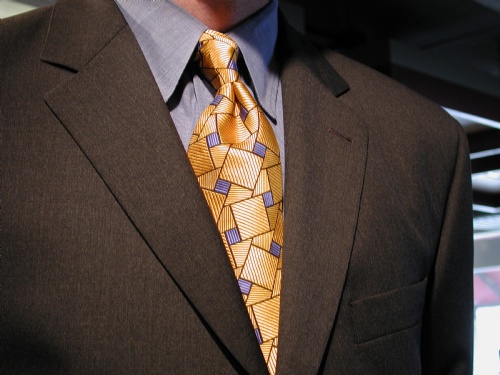
Image credit: Mike Johnson
Moshe was trudging through the Sahara, thirsty and weak. When he spied something in the distance, he thought his eyes must be playing tricks on him. As he got closer, he recognized Hymie sitting in front of a table selling ties.
“Would you like to buy a tie?” Hymie offered.
“I’m dying, I need a drink of water! I have no use for a tie,” Moshe managed to reply.
“Well head over this hill behind you for a few miles. You’ll come across a restaurant, they should have water.”
A few hours later, Moshe crawled back to the table where Hymie was calmly sitting. In a raspy voice he cried out to Hymie, “Please, I need to buy a tie.”
“They couldn’t help?” Asked a concerned Hymie.
Moshe replied, “You could have warned me that your brother wouldn’t let me in without a tie!”
Speaking of ties reminded me of the question that has been asked recently, is wearing a tie a thing of the past? Some people think it isn’t; in fact that was the primary advice Donald Trump recently had for President Obama: Wear a tie!
Not to equate the two, but interestingly, ties were deemed important enough for Rabbi C. M. A. Hodakov, the Rebbe’s Chief of Staff for many years, that one of the guidelines that he advised Chabad yeshiva students on their way to visit outlying Jewish communities was: Wear a tie.
Although the Torah doesn’t have an official position on ties per se, this weeks Torah portion does speak of a different type of uniform: that of the Kohanim, or priests. While doing their service in the Temple, the Kohanim were required to wear a certain set of clothing.
The clothing of the kohanim was due to their responsibility in the Temple; they were charged with a unique mission and the way they dressed reflected their life-mission.
Although external in many ways, clothes truly "make the man" (or woman). They communicate who we are. Companies recognize this and expect a certain dress code, if not an actual uniform, from their employees. Chassidic communities are famous for their unique way of dressing.
Jewish tradition definitely places importance on the way we dress, recognizing the ability of our clothes to influence not only what people think of us, but even the way we act.
Here’s a question for you to ponder: do you dress in a conscious manner, in line with your goals, values and way of life; or do you dress the way that society expects you to dress?